

More network coverage doesn’t automatically mean more customers. ISPs still need to turn serviceable addresses into subscribers, stand out when competitors make similar speed and price claims, and give customers a reason to stay once they sign up.
That makes ISP marketing is as much a coordination challenge as an acquisition one. Audience targeting, content, channel mix, customer data, local marketing, and retention all need to work toward the same commercial goals.
At Postalytics, we work with Fiber/Broadband Providers to connect automated direct mail with the wider marketing stack. In this guide, we’ll look at nine best practices for building a more targeted, measurable, and connected ISP marketing strategy.
What we’ll cover
What is an ISP marketing strategy?
Why an ISP marketing strategy matters
9 best practices for ISP marketing strategy
1. Target your audience with meaningful segmentation
2. Connect your marketing channels around the customer journey
3. Create content around real customer decisions
4. Measure the metrics that drive subscriber growth
5. Use customer feedback to improve engagement and retention
6. Align marketing with the customer lifecycle
7. Localize marketing around the markets you serve
8. Build partnerships that extend local reach
9. Differentiate beyond speed and price
How automated direct mail supports your ISP marketing strategy
Build a more connected ISP marketing strategy
What is an ISP marketing strategy?
An ISP marketing strategy is twofold. It maps out how an ISP plans to capture potential customers’ attention and maintain the loyalty of its existing users.
Unlike businesses that can sell almost anywhere, ISPs operate within defined network footprints. Marketing needs to reflect where service is available, which households and businesses can actually connect, and how customer needs differ across neighborhoods and service areas.
An effective strategy brings together several elements:
- Audience segmentation: Identifying the households and customer groups most likely to need or switch services
- Positioning: Giving customers a compelling reason to choose your service beyond speed and price alone
- Channel mix: Coordinating channels such as search, email, social media, direct mail, and local marketing
- Customer lifecycle: Supporting acquisition, onboarding, engagement, upgrades, retention, and win-back
- Measurement: Connecting marketing activity with subscriber growth, retention, and revenue
The best ISP marketing strategies connect these elements rather than treating each campaign or channel in isolation.
Why an ISP marketing strategy matters
A well-defined ISP marketing strategy provides the foundation for turning network coverage into sustainable subscriber growth. It connects customer acquisition, retention, positioning, and measurement around clear commercial goals.
Marketing can then help providers:
- Increase subscriber penetration within serviceable markets
- Acquire customers more efficiently by focusing spend on the right audiences and locations
- Differentiate from competing providers when speed and price claims are similar
- Improve retention and customer value through better onboarding, engagement, upgrades, and renewal activity
- Measure commercial impact by connecting campaigns with signups, installations, churn, and revenue
This becomes more important as broadband competition increases and customer journeys span more digital and offline touchpoints. Effective strategies give each channel and campaign a clear role in moving customers from awareness to signup and long-term retention.
9 best practices for ISP marketing strategy
Building that strategy requires several disciplines to work together, from audience targeting and content to channel integration, customer engagement, localization, and measurement.
The following nine best practices provide a framework for building a strategy around how and where your ISP can compete, acquire subscribers, and create long-term customer value.
1. Target your audience with meaningful segmentation
ISP segmentation starts with serviceability. Before deciding what message to send, providers need to know which households and businesses they can actually serve.
But an address alone doesn’t tell you enough about the customer behind it. From there, audiences can be segmented using factors such as:
- Geographic location and service availability
- Prospect, new customer, or existing subscriber status
- Current plan and upgrade eligibility
- Customer lifecycle stage
- Behavioral and engagement data
- Household or business needs
This richer customer data creates a stronger basis for personalization. A household that has just become eligible for fiber, for example, should receive a different message from an existing subscriber eligible for an upgrade or a customer whose engagement has declined.
It’s an important distinction in broadband marketing. As Jarie Bolander of Decision Counsel puts it, “you’re not an address.” Providers need to understand the customer behind that address and use what they know to make communications more relevant.
Platforms such as Calix Engagement Cloud give broadband providers access to richer customer and service data that can be used for segmentation and personalization. Postalytics integrates directly with Calix Engagement Cloud, allowing those audiences to inform personalized, trackable direct mail alongside other marketing channels.
That could mean triggering a relevant mailpiece when a household becomes serviceable, qualifies for an upgrade, or reaches another defined point in the customer journey.
Want to see how to build marketing around serviceability and subscriber opportunity? Read our guide to broadband marketing strategies for growth.
2. Connect your marketing channels around the customer journey
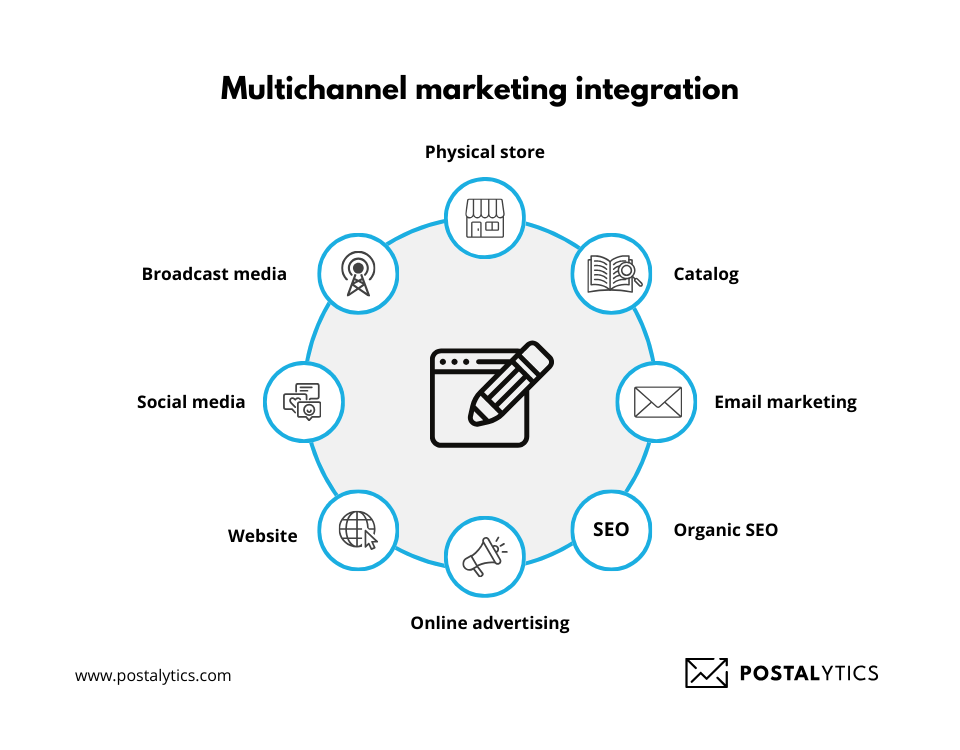
Multi-channel marketing works best when channels share data and support the same customer journey.
An ISP prospect might see a local paid campaign, check service availability online, receive a follow-up email, and later receive direct mail reinforcing the offer. Each touchpoint should build on what the provider already knows about that household.
That requires coordination across channels such as:
- Paid search and social media
- Email and SMS
- CRM and marketing automation
- Local and community marketing
Postalytics can bring direct mail into these connected workflows. MailBack™ can use high-intent website behavior to trigger personalized mail to qualifying anonymous visitors, while Postalytics Flows can automate multi-touch direct mail journeys using timing, branching logic, and suppression rules.
The goal is a connected experience where activity in one channel helps determine the next best touchpoint.
For a deeper understanding of how ISP data, triggers, personalization, and fulfillment connect, see our guide to automated broadband direct mail.
3. Create content around real customer decisions
ISP content should help customers make better decisions before and after signup.
That means creating content around the questions people ask when choosing, installing, and using broadband, such as:
- Whether service is available at their address
- Which broadband speed or plan suits their needs
- What to expect during installation
- How fiber compares with other connection types
- What changes when new services become available
- Which upgrades, bundles, or additional services are worth considering
Local content can be particularly valuable when providers enter new markets or expand their networks. Pages and campaigns built around specific service areas, rollout updates, and availability can capture more relevant demand than broad content alone.
The goal is to make content useful at the point a customer needs it, while reinforcing the provider’s value proposition throughout the buying journey.
4. Measure the metrics that drive subscriber growth
ISP marketing should be measured against commercial outcomes, not just reach, clicks, or campaign engagement.
Useful metrics include:
- Cost per acquired subscriber
- Signup-to-installation conversion rate
- Subscriber penetration by serviceable area
- Upgrade and renewal rates
- Customer churn
- Customer lifetime value
- Campaign ROI
These metrics help providers understand where growth is coming from, which markets or campaigns deserve more investment, where customers are dropping out, and how digital and offline channels contribute to acquisition and retention performance.
Modern direct mail can support that measurement with delivery tracking, personalized QR codes, pURLs, and CRM attribution. See how Ritter Communications used automated direct mail to scale its broadband marketing while improving visibility into campaign performance.
5. Use customer feedback to improve engagement and retention
Customer feedback can reveal where the subscriber experience is working and where friction is putting relationships at risk.
Surveys, reviews, support interactions, cancellation reasons, and engagement data can help ISPs identify recurring issues across the customer journey. That might include confusion during onboarding, dissatisfaction with a plan, low adoption of available features, or problems that increase the risk of churn.
The value comes from turning those signals into action. Feedback can inform service improvements, customer communications, educational content, upgrade offers, and retention campaigns, while helping marketing teams understand which messages resonate with different customer groups.
This creates a useful feedback loop: customer behavior and sentiment inform the strategy, and the resulting campaigns become more relevant to what subscribers actually need.
6. Align marketing with the customer lifecycle
ISP marketing should not stop once a customer signs up. Different stages of the customer lifecycle create different opportunities to support retention, increase customer value, and strengthen the relationship.
That’s a gap Gabe Petersen, Senior Director, Field Strategy at Calix, sees across the industry. Providers often focus heavily on acquisition and then, as Petersen puts it, “we completely forget about the touchpoints that can happen across the entire journey.” Read our conversation with Gabe Petersen.
That might include:
- Onboarding and installation support
- Ongoing engagement and education
- Upgrade and cross-sell opportunities
- Renewal communications
- Churn prevention
- Win-back campaigns
The important part is matching the message to the customer’s current stage rather than treating every subscriber the same.
7. Localize marketing around the markets you serve
ISP markets can differ significantly by neighborhood, town, or service area. Network availability, competitive pressures, customer needs, and the services you can offer may vary from one location to another.
Marketing should reflect those differences. For example, a new fiber market may need awareness and education before launch, while an established service area with several competing providers may need stronger differentiation or switch-focused messaging.
Providers can localize campaigns around factors such as:
- Service availability and rollout stage
- Local competitors and customer alternatives
- Plans, speeds, and upgrades available in the area
- Community events, partnerships, or local proof points
- Offers relevant to a particular market
Channels can then follow the same local strategy. Direct mail, for example, can reach specific serviceable addresses rather than treating an entire region as one audience.
For more tactical ideas on turning local availability into subscriber acquisition, see our ISP marketing playbook.
8. Build partnerships that extend local reach
Partnerships can help ISPs build credibility and reach customers through organizations that already have a presence in the markets they serve.
Relevant partners might include:
- Property developers and housing communities
- Local businesses and chambers of commerce
- Community organizations and events
- Technology or service partners
- Referral and co-marketing partners
For example, a provider entering a new development could work with the property developer on launch communications, while a regional ISP might partner with local organizations to strengthen awareness and trust in a new service area.
The best partnerships support a clear marketing objective, whether that is reaching newly serviceable households, generating referrals, increasing local visibility, or reinforcing the provider’s position in the community.
9. Differentiate beyond speed and price
Speed and price are important buying factors, but they are rarely the only ways an ISP can stand apart. When competing providers offer similar plans, the wider customer experience can become an important part of the value proposition.
Differentiators might include:
- Whole-home Wi-Fi performance and coverage
- Security and privacy features
- Installation experience
- Customer support and responsiveness
- Flexible plans or bundles
- Relevant upgrades and add-on services
- Reliability and service guarantees
The right differentiators will depend on the market and customer segment. Marketing should identify which benefits matter most to each audience and make those advantages easy to understand.
This gives ISPs a stronger position than competing on promotional pricing alone and provides more reasons for existing subscribers to stay, upgrade, or expand their services.
How automated direct mail supports your ISP marketing strategy
Automated direct mail can support many of these strategies when it is connected to the same customer data and marketing systems ISPs already use.
With Postalytics, broadband providers can bring direct mail into their wider marketing workflows to:
- Target serviceable households: Use geographic and customer data to reach specific addresses within your network footprint.
- Personalize campaigns: Adapt messaging and offers based on location, service availability, customer status, or other audience data.
- Respond to customer behavior: Use MailBack™ to follow up with qualifying anonymous website visitors after high-intent activity.
- Automate multi-touch journeys: Use Postalytics Flows to coordinate sequences across acquisition, onboarding, upgrades, retention, and win-back.
- Connect direct mail with your marketing stack: Integrate campaigns with CRM and marketing automation platforms so direct mail can work alongside your digital channels.
- Measure campaign performance: Track mail delivery and responses using USPS delivery data, personalized QR codes, pURLs, and connected campaign data.
This turns direct mail from an isolated campaign into a measurable channel that can support the wider ISP marketing strategy.
Build a more connected ISP marketing strategy
As the battle for broadband supremacy continues unabated, a well-planned ISP marketing strategy is more critical than ever.
But it’s about more than selling the service. It’s about building lasting, meaningful customer relationships that propel premium service and your brand above the competition.
That means aligning acquisition with serviceability, using customer data to make campaigns more relevant, measuring performance against subscriber outcomes, and continuing to engage customers beyond the initial signup.
When those elements work together, marketing becomes better equipped to support growth across both new and established service areas.
Postalytics helps broadband providers integrate automated, personalized, and measurable direct mail into their broader strategy.
Explore Postalytics for Fiber/Broadband Providers or create a free account to get started.
About the Author

Dennis Kelly
Dennis Kelly is CEO and co-founder of Postalytics. Dennis joined Boingnet, the predecessor to Postalytics, in 2013. Boingnet was focused on providing print and direct mail marketing service providers the ability to add digital marketing channels to their direct mail campaigns. Postalytics is Dennis’ 6th startup. He has been involved in starting and growing early-stage technology ventures for over 30 years and has held senior management roles at a diverse set of large technology firms including Computer Associates, Palm Inc. and Achieve Healthcare Information Systems.